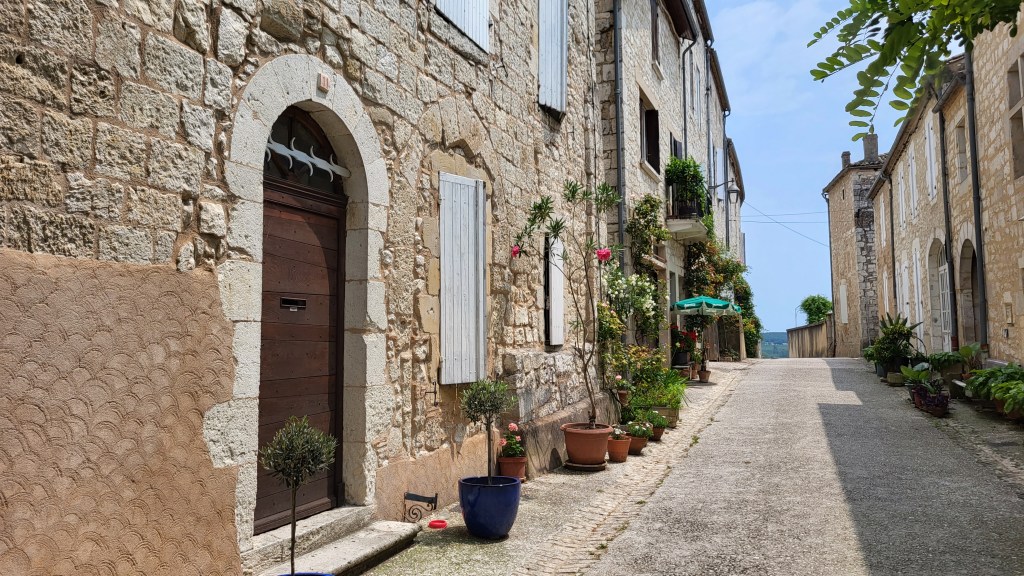
There’s something about Monflanquin that instantly pulls you in. Maybe it’s the way the honey-colored stone catches the afternoon light, or how the narrow streets seem to whisper centuries of stories as you wander through them. But for me, Monflanquin will always be about a small garden and an unexpected connection.

The first time my wife and I visited the village in 2023, we weren’t seeking out history or landmarks—we were just enjoying a quiet stroll, taking in the details that make a place feel alive. That’s when we noticed it: a tiny vegetable and herb garden spilling out of pots and window hangers, carefully arranged outside a modest stone home. Basil, thyme, tomatoes, chives—each plant thriving in the smallest of spaces, tended with obvious care.
As we stood there admiring the ingenuity of it, an elderly woman rounded the corner. She caught us off guard with a direct question in French: “Qu’est-ce que vous faites là?” What are you doing there?
Caught somewhere between embarrassment and admiration, we scrambled to explain in broken French that we were simply appreciating her work. With a gentle nod and a smile, she seemed to approve, and just like that, we spent the next hour in an impromptu language and gardening lesson.
With my limited French, her patience, and a little help from Google Translate, we exchanged words for plants in each other’s languages. She proudly swiped through her phone to show us pictures of meals she had made from her tiny garden, and with a warmth that needed no translation, she invited us to taste the herbs and tomatoes she had so carefully grown. They were, without exaggeration, incredible—bursting with flavor in a way that only homegrown produce can be.
Somewhere in that hour, she also took it upon herself to teach me a few phrases to help me “sound more like a local.” I tried my best, but no matter how earnestly I repeated after her, my Canadian accent was a dead giveaway. She laughed kindly at my attempts, the way a grandparent might at a child just learning to speak.
She was too shy to let us take a photo with her, but she was more than happy for us to capture the garden itself—a quiet testament to the way the French make the most of what they have, whether it’s a small space or a moment of connection with strangers.
And that’s something I’ve come to love about this part of France. The people here in the southwest have a warmth that isn’t always loud, but it’s genuine. If you show interest in their culture, their food, their history, they will meet you with stories, kindness, and a generosity that turns a chance encounter into a cherished memory.
For anyone visiting Monflanquin, I’d say this: yes, take in the beauty of the medieval square, admire the views from the hilltop, and soak in the history of this bastide town. But also, slow down. Notice the little things. Strike up a conversation, even if you fumble through the words. Because sometimes, the most memorable experiences aren’t the ones we plan—they’re the ones that find us when we least expect them.


 Wander in France
Leave a reply to Why Visit Southwest France: France’s Best-Kept Travel Secret – Wander in France Cancel reply